Glimtide Is Coming to Steam: What Changed in Nine Days
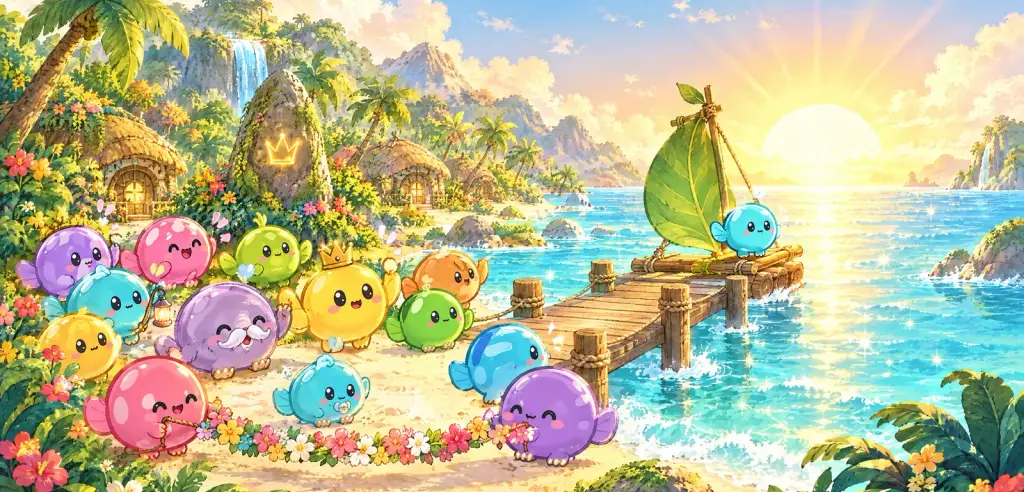
Glimtide, my living-island life sim, now has a Steam page and heads to Early Access in Q1 2027. Why I removed every coin and what the game got since.
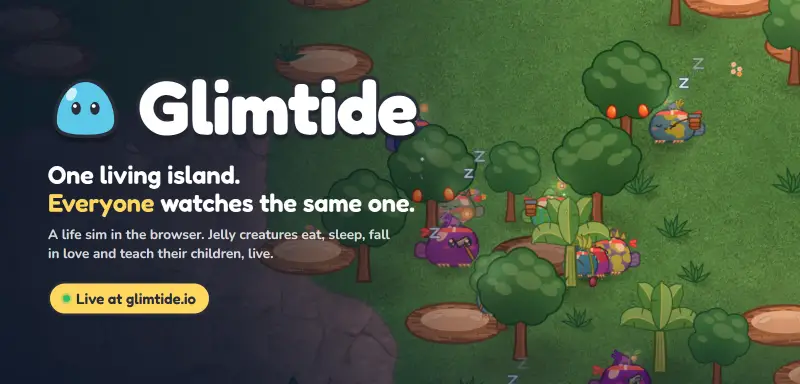
Nine days ago I wrote about Glimtide, a browser game where small jelly creatures live on one shared island that never stops. Today it has a page on Steam: Glimtide on Steam. It is listed as Coming Soon, it launches in Early Access in the first quarter of 2027, and you can add it to your wishlist now.
A lot changed on the way there, including the business model and the platform. This post covers what changed and why.
"A beautiful world, but not yet a game"
Before deciding anything about Steam, I sat down and looked at the live island the way a new player would, then compared it with the games it will sit next to in the store: WorldBox, RimWorld, Creatures, Neko Atsume, Rusty's Retirement. I wrote the result down in a design document, and the scores were not flattering.
- Watching it: 7 out of 10. The first fifteen minutes are lovely, and then there is not enough drama in front of your eyes.
- Playing it: 3 out of 10. The player barely decides anything.
- The first thirty seconds: a blue screen with "Connecting…", then the island from far away, with glims a couple of pixels tall. The game is pretty up close and greets you from a distance.
The summary line in that document was "a beautiful world, but not yet a game." It named four things a hit needs and Glimtide lacked: something that is yours, decisions without control (you influence, the glim still decides), other people you can see, and moments you can share. The rule that nobody steers the glims stays. Everything else was open to change.
No coins at all
The browser version had gold coins. Treats, games and pranks cost coins, you could buy packs, and payments went through Xsolla. It worked technically, and it was the wrong model. Paying to feed your pet is pay-to-care. Paying to drop a meteorite on a stranger's glim is pay-to-grief. Steam reviews punish both, and the document called that combination "the worst one possible".
So on 27 October I took coins out completely: wallets, packs, the shop, the payment webhooks, the admin section and every price tag in the interface. Glimtide on Steam is a one-time purchase. Everything on the island is included, with no in-game purchases and no currency to top up. Actions keep their cooldowns and the world's limits, so a meteorite is still rare. It is just no longer for sale.
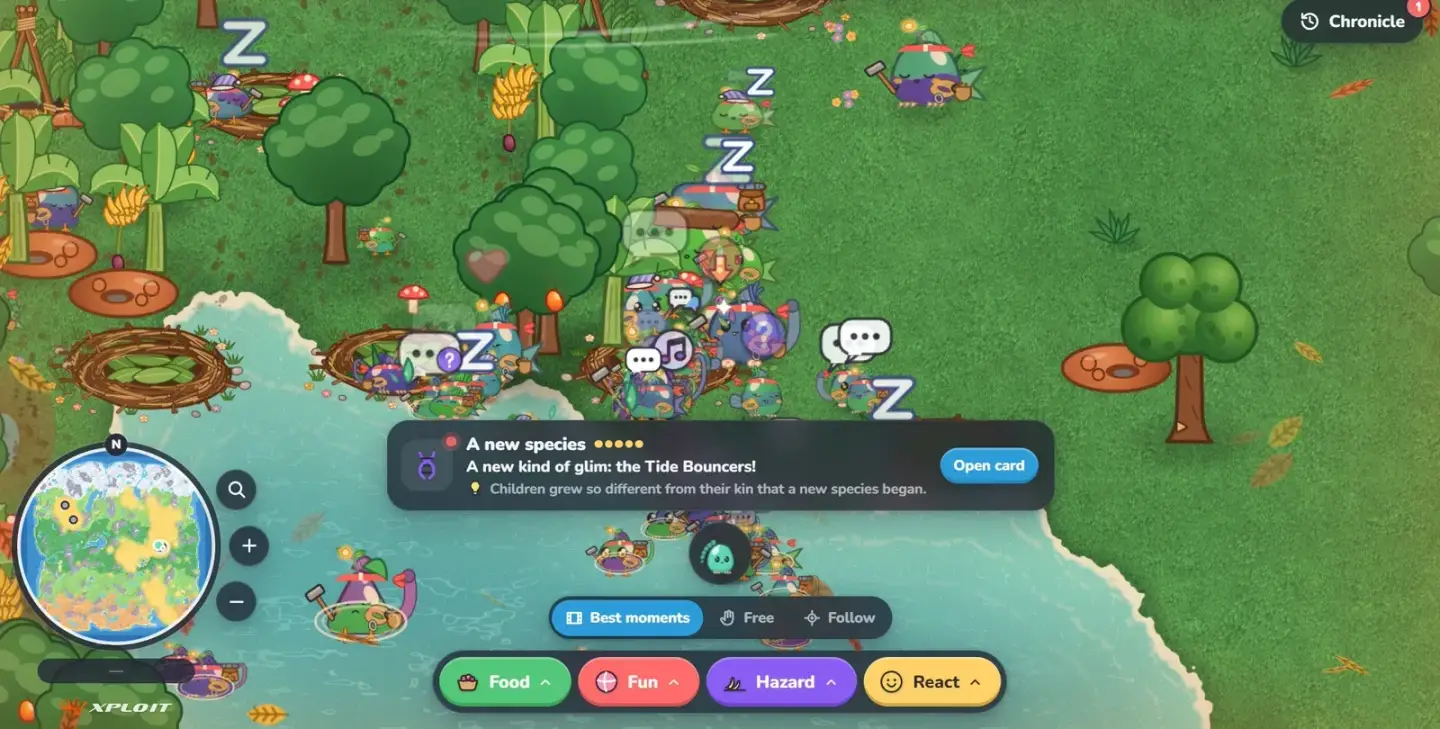
The browser has a new role as well. At play.glimtide.io you can still watch the same island for free, as a demo: follow a glim, read its thoughts, open its card. Treats, fun, mischief, adoption and your own species are in the Steam version. Both kinds of players share one world and one chronicle.
A PC game first
Glimtide is now a game for Windows, macOS, Linux and Steam Deck. The Steam client is Electron with steamworks.js around the same web client, and macOS builds are signed and notarized in CI. I removed the mobile layout entirely, along with the bottom sheets, rails and phone layouts. There is one layout, and it has to look right on any PC monitor and on a Deck at 1280 × 800. On 2K and 4K screens the interface scales up, and on a slow machine the glass panels turn matte and there are fewer particles.
Dropping phones was a hard call, because the browser game started there. But supporting both meant two interfaces, and Steam players judge a game by how it looks on their own screen.
The first two minutes
Most people decide about a game in the first two minutes, and that was the weakest part. Now it goes like this:
- A loading screen with five bouncing glims ("Sailing to the island…", "Looking for something interesting…") instead of a blank blue page.
- A cold start on a hot spot. The gateway sends a newcomer the director's current shot right after the handshake, not twenty seconds later. For the first two minutes the camera picks the hottest spot on the island if it beats the director's choice.
- The hero up close. The camera zooms until the glim in the shot is about 64 pixels tall. "Ordinary life" no longer shows the first glim it finds: the director picks the liveliest activity it can see, such as building, healing, playing or looking after a baby.
- Subtitles. The hero's name and current thought float above its head, like in its card.
- Hot spots. Up to eight places where something is happening (a hunt, a birth, a wildfire, a new village) pulse on the minimap and show as arrows at the screen edge.
- Three buttons for newcomers for the first hour: Care, Watch and Find yours, instead of four menus.
Decisions without control
The glims still decide for themselves, but the player now has real choices to make.
- Faith and miracles. Glims you help come to believe in you and bring faith points. Faith pays for three miracles: a grove harvest, rain over a drought, a warm night. The more followers you have, the further your miracles reach. You cannot buy faith, and it fades if you stop caring.
- Whispers. A keeper can whisper one of three pieces of advice to their pet. Whether the glim listens depends on its personality and trust, and a glim that hears a lot of whispers later runs from danger sooner.
- Matchmaking. Introduce your pet to a single glim. The other glim decides. Children of close relatives (a shared grandparent) are born weak, and that is now a rule of the world.
- Rescues together. Viewers put out a wildfire by clicking on the flames, and drive off a hunting shark by throwing pebbles.
- Wishes. A glim you are watching sometimes asks for something small: a treat, a game, some praise, help finding a parent or a friend. One click grants it, and the glim thanks you with its own animation.
Something that outlives your glim
A glim lives a short life, and the old version had nothing left over when one died. Now:
- An egg from a nest. Take an egg from a glim expecting a baby and give the baby a name. It hatches in front of you and is in your care from its first second.
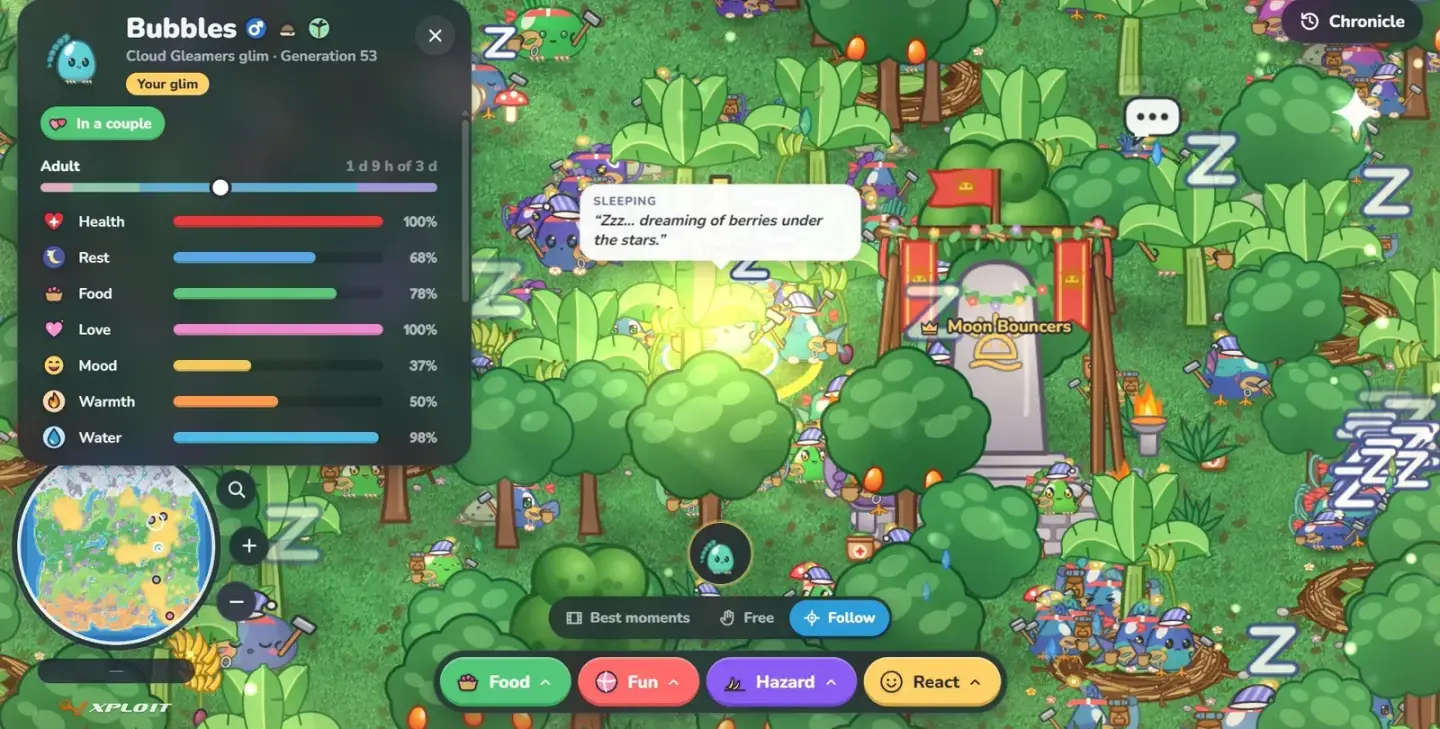
- Dynasties. When your pet dies, care passes to its eldest living child, or to a grandchild. The heir carries the founder's name with a number ("Blobby II"), and the family collects the fame of its generations.
- Your glim knows you. When your camera rests on your pet, it waves, and sometimes runs up to the screen.
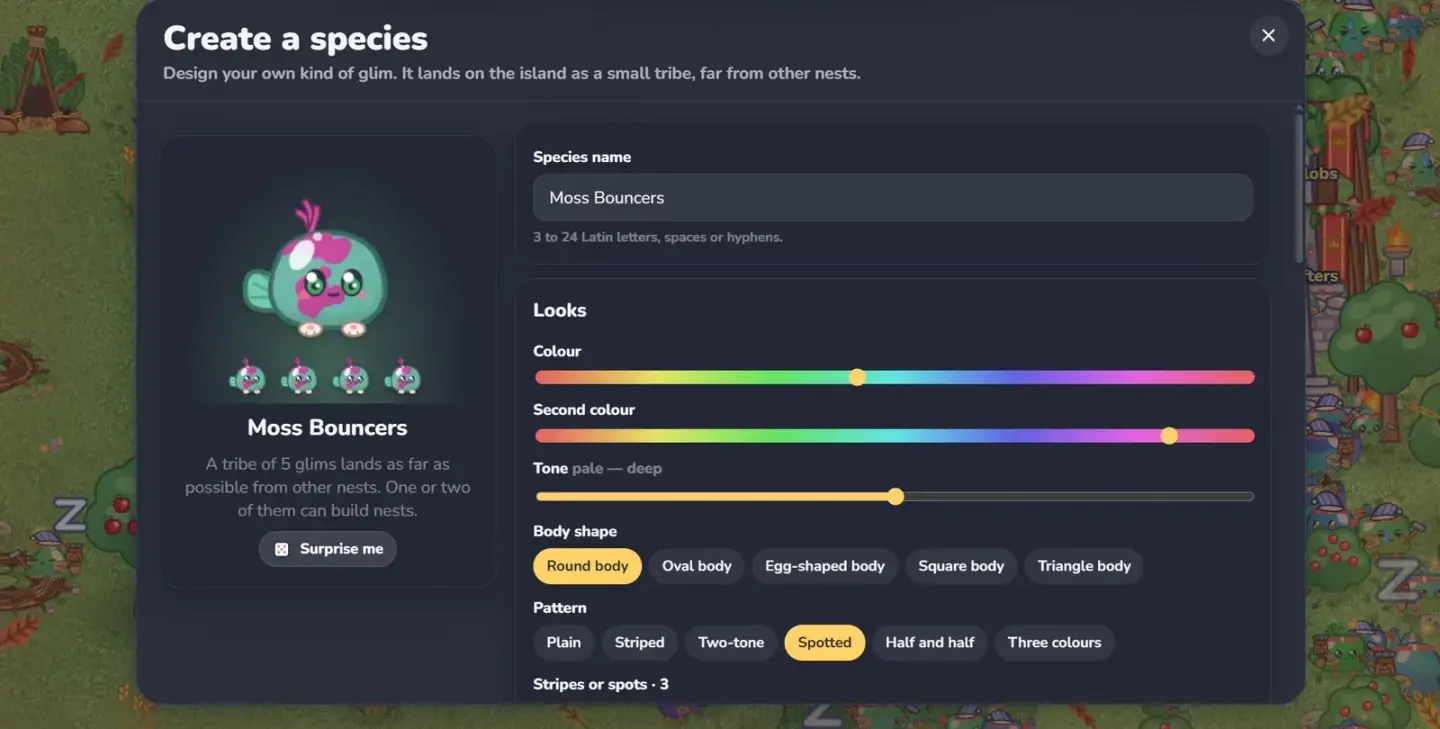
- Relics. A species that dies out leaves relics for what it did (a totem, a chief's feather, a founder's stone, an elder's staff) and a line in the Hall of Fallen Species. Your next species can take one relic, which gives its founders a bonus that comes with a drawback.
- Hide and seek. Young glims play hide and seek behind real cover on the island. Your own little pet hides on your screen only, and you are the only one who can find it.
Other people, and a way out of the game
There is no chat in Glimtide and there will not be. I decided that on purpose: free text in a cute shared world is a moderation job I do not want, and it is not what the game is about. Other players show up in other ways:
- Fireflies. Every viewer is a firefly where their camera is looking. Glims standing under a cluster of fireflies look up at them.
- Jelly cursors. The game draws its own cursors from the same jelly as the glims: a dart with a glim fin, jelly hands, 29 kinds in all.
- Clips with one button. "Clip" saves the last 15–30 seconds of the island as a vertical 9:16 video with the island's sound, chronicle subtitles and the logo, ready for Shorts, Reels and TikTok.
- Share links. Any glim, species or place gets a short link that opens with a preview card in Discord, Telegram and X and drops the visitor right at that glim.
- A desktop aquarium. This one is Steam only. It is a transparent strip along the bottom of your screen where your pets, their partners and their babies walk around in their real current state, with grass, a hut and a campfire that burns at night. The mouse passes through it, and clicking a glim opens the game right next to it. It is the idea Rusty's Retirement proved: a game that lives at the edge of your desktop while you work.
Music and eleven languages
The island has a soundtrack now: 23 tracks I made in Suno, mixed live by a small music director in the client. It works like a sound engineer. It picks tracks by time of day, the ground under the camera and the season, changes keys smoothly around the circle of fifths, crossfades on bar boundaries, freezes the background music under a chase and resumes it from the same second, and jumps to the release point of a track when the glim gets away.
The game is also translated into eleven languages: English, French, Italian, German, Spanish, Japanese, Korean, Russian, Simplified and Traditional Chinese, and Vietnamese. That covers 1,693 interface strings per language plus the texts of every world module. The narrator, which retells important chronicle lines with Claude, now writes each retelling in all of them at once. Nine agents did the translations, one per language, so terms stay consistent within each language. Native speakers still need to proofread them, starting with Japanese, Korean and Chinese.
Under the hood
A good part of the last ten days went into making the world big enough for Steam traffic:
| World modules | 41, every one of them able to run in regions |
| Island | about ten times the area of the first version |
| 20,000 glims | about 43 ms per frame in one thread |
| 50,000 glims | 93 ms on 6 workers, against 224 ms in one thread |
| Gateways | several, coordinated through Postgres LISTEN/NOTIFY |
| Tests | 532, plus a deterministic world fingerprint |
The big change is regions. The island can split into regions with a Bun Worker each, with ghost entities at the borders, a mirror of the whole island for decisions that need all of it, and patches for shared resources. The world fingerprint (a fixed seed, a run, and a hash of the whole world) is how I check that an optimisation which should not change behaviour really did not change it.
The evolution of the world itself works as before: the glims' deeds ripen a seed of evolution, players vote on one of three turns, and the winner installs into the live island without a restart. More than fifteen turns are waiting in the pool.
What Early Access means here
I plan about a year of Early Access. A world that grows new rules while it runs needs real players to tune it: how long glims live, how harsh winter is, which mischief feels fun and which feels unfair. Players already pick the next turn of evolution, and I tune food, mischief and cooldowns without stopping the island. The full version should have every turn from today's pool plus new ones, a well-balanced world where glims live long lives, and full Steam Deck support. The core stays the same: one island for everyone, free to watch.
If this sounds like your kind of game, wishlist Glimtide on Steam. Wishlists are how a small game gets seen at launch. You can watch the island for free at play.glimtide.io, and the game page with the press kit is here.