How We Made the First Episode of Tiny Boo
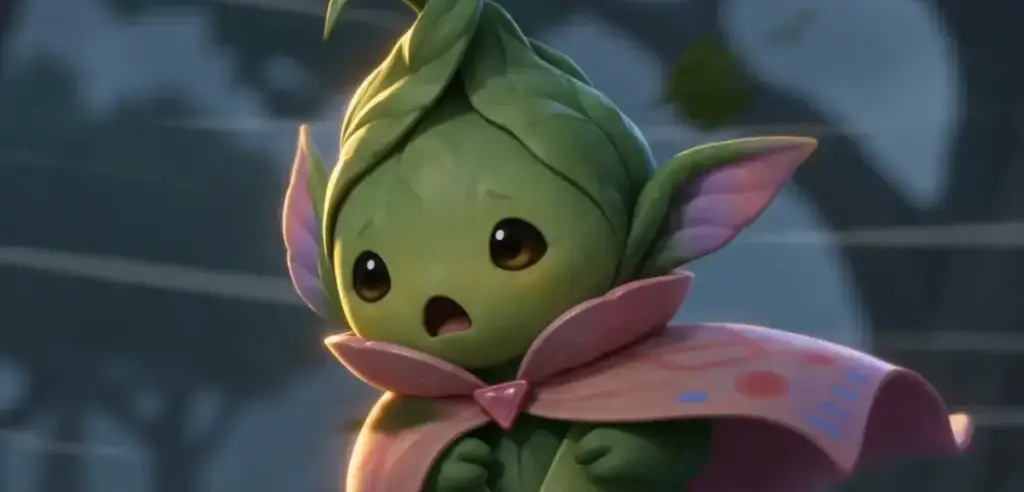
Let me start with where all of this came from. We have a game — Tiny Boo: Homecoming, a story about a tiny creature named Boo who gets lost and makes his way home across a huge world.
Let me start with where all of this came from. We have a game — Tiny Boo: Homecoming, a story about a tiny creature named Boo who gets lost and makes his way home across a huge world. At some point that world, Lumia, started to feel too big to keep inside a game. We wanted to show it differently — not as levels and mechanics, but as short stories you can just watch in the evening, when you have no energy left for anything else.
That's how Tiny Boo ended up on YouTube. The idea is almost embarrassingly simple: a warm cartoon with no words. No words at all.
YouTube video
Why no words
That was the first decision, and probably the most important one. The moment you take out dialogue, the story stops belonging to a single language. People understand it the same way in Moscow, Manila and São Paulo — there's nothing to translate, everything rests on action and expression. For us that was the whole point: to make something that works across borders.
There was a practical side too. We build the video with neural nets, and getting clean lip-sync with a consistent voice out of that kind of tech is its own headache — one it's more honest to sidestep than to heroically conquer. But if it were only about production, we wouldn't have built the whole thing around it. Here, being wordless isn't a compromise, it's a personality. Boo isn't supposed to talk anyway — his ears, his eyes and the way he clutches his little cape say it for him.
We had good reference points to lean on: Pingu, Larva, Shaun the Sheep, La Linea. None of them ever needed subtitles.
Who Boo is
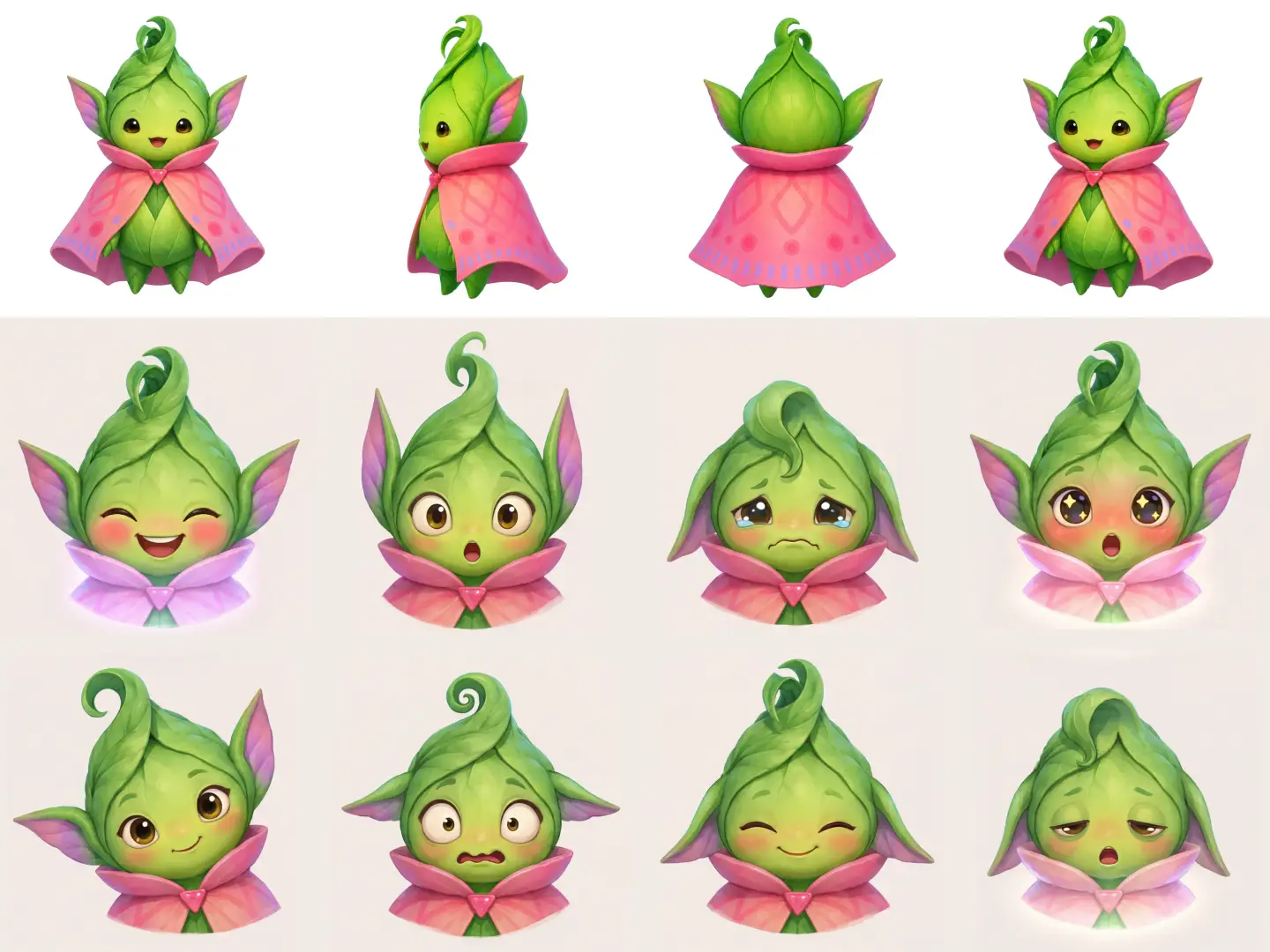
Boo is a tiny forest spirit shaped like a closed flower bud. The body is teardrop-shaped, made of folded leaves with visible veins, and the leaves on top of his head curl into a little spiral tuft that works as a mood antenna: it springs up when he's happy and droops when he's tired. Big leaf-shaped ears, green on the outside and soft pink within. Small dark eyes with bright highlights. No nose at all — and it turns out he doesn't need one; the face reads perfectly fine without it.
We boiled his character down to three traits: curiosity, naivety and fearlessness. It sounds sweet, but that exact mix is where both the humor and the tension come from. Boo walks straight into places a smarter creature would avoid — simply because he's curious. The world, meanwhile, isn't cruel, so everything ends up warm in the end, but the road to that "warm" can get tense.
And there's one detail the whole thing hangs on — the cape. A pink-lilac petal with a heart-shaped clasp, faintly glowing. It's a gift from home. Boo guards it the entire way as a thread back to his family. When we need to show that he's pulled himself together, we don't need words — he just grips the cape with both hands.
The story of the season
The first season is called The Long Way Home. The setup is short: a storm tears Boo and his friends off their home tree and scatters them across the wild forest. The rest is the road back, through four "shades" of forest — from the bright and carefree, through the anxious yellow and the frightening dark, and back to the light again, but this time at home.
Along the way Boo finds the friends the same storm blew apart. But for one reason or another, none of them can keep going right then, and Boo promises to come back for them with help. Those promises stack up over the whole season so they can pay off all at once in the finale: Boo makes it home, leads a rescue party back out, and gathers everyone at the home tree. The episodes still stand mostly on their own — you can watch most of them separately — but a single thread runs through the whole season.
Episode one: "Carried Away"
The first episode is that very setup, the moment everything starts from. In Russian it's called "Унесённый," and there's a nice double meaning in the English title: Boo is physically carried away by the storm, and "to be carried away" also means to be moved to tears. Which is more or less exactly what we're after.
We wrote the script in action, not lines — laying out what happens on screen and what the character feels while it does. The episode is split into three acts.
Act one is home. A golden morning on a very tall tree, the forest below in a warm haze, a glowing hollow, the bud-family. Boo plays carelessly with his friends, Po and Marci — tag and hide-and-seek — climbs higher than anyone and hides right at the top. Down below the family waves, Boo waves back and adjusts his cape. All is well. We deliberately let this moment breathe — so that there's something to lose.
Act two is the storm. The sky darkens, the leaves begin to tremble, everyone's ears prick up. Then a sharp gust, a tornado, rips them all off the branch. Boo is caught in the spinning current, whirled around in a spiral of torn leaves and petals, reaching for the branch slipping away from him. Po is swept one way, Marci another; they reach for each other, but the wind pulls everyone apart. And the home tree shrinks fast into the distance. This is the episode's emotional gut-punch — and the setup for the whole rescue line of the season.
Act three is the forest edge. The wind dies as suddenly as it came. Boo comes to on a strange mossy branch, right at the edge of an unfamiliar forest. Fog, silence, dripping water. He looks around for his friends and his home — no one. His ears drop, the tuft sags. And that's when he notices the cape on himself, grips it, and gathers his courage. He lifts his gaze to the forest and takes a first steady step. The camera pulls up: a tiny Boo at the edge of an enormous world, the road ahead of him.
It mattered to us that an episode about loss ends not in despair but in hope. Small, frightened, alone — but walking.
How it was put together
Technically, each episode is dozens of short shots, three to eight seconds each, generated and then assembled in the edit. The hardest part is consistency — making sure Boo is the same creature in every shot. To handle that we locked his look down in advance in detailed reference sheets, and we carry the same set of traits into every shot — the bud silhouette, the spiral tuft, the pink inner ears, the cape with the heart clasp. The first episode was a real stress test: it's the first time several characters share the frame at once, and we deliberately built the scatter scene out of separate single shots — easier on the tech, and it introduces each friend in a big close moment.
Sound was done separately. In the first act, a warm home theme on ukulele and piano. In the storm, a rising rumble and an anxious register the series hadn't used before. Then a hard cut to silence at the forest edge, and out of it a quiet, hopeful motif emerges on that first step. Boo does have a voice, but it isn't words — it's gibberish vocalizations: laughs, sighs, a determined little "hm."
We work in a small way and slowly — this is a side project, not a studio pipeline. So the first episode is less a "premiere" for us than proof that the whole idea actually holds together: that a wordless story about a tiny brave creature can hit you somewhere real.
From here, it's the road home. Boo still has friends out in that forest, and he promised to come back.